Vectra - HYPER UNISON
Explore Infinite Possibilities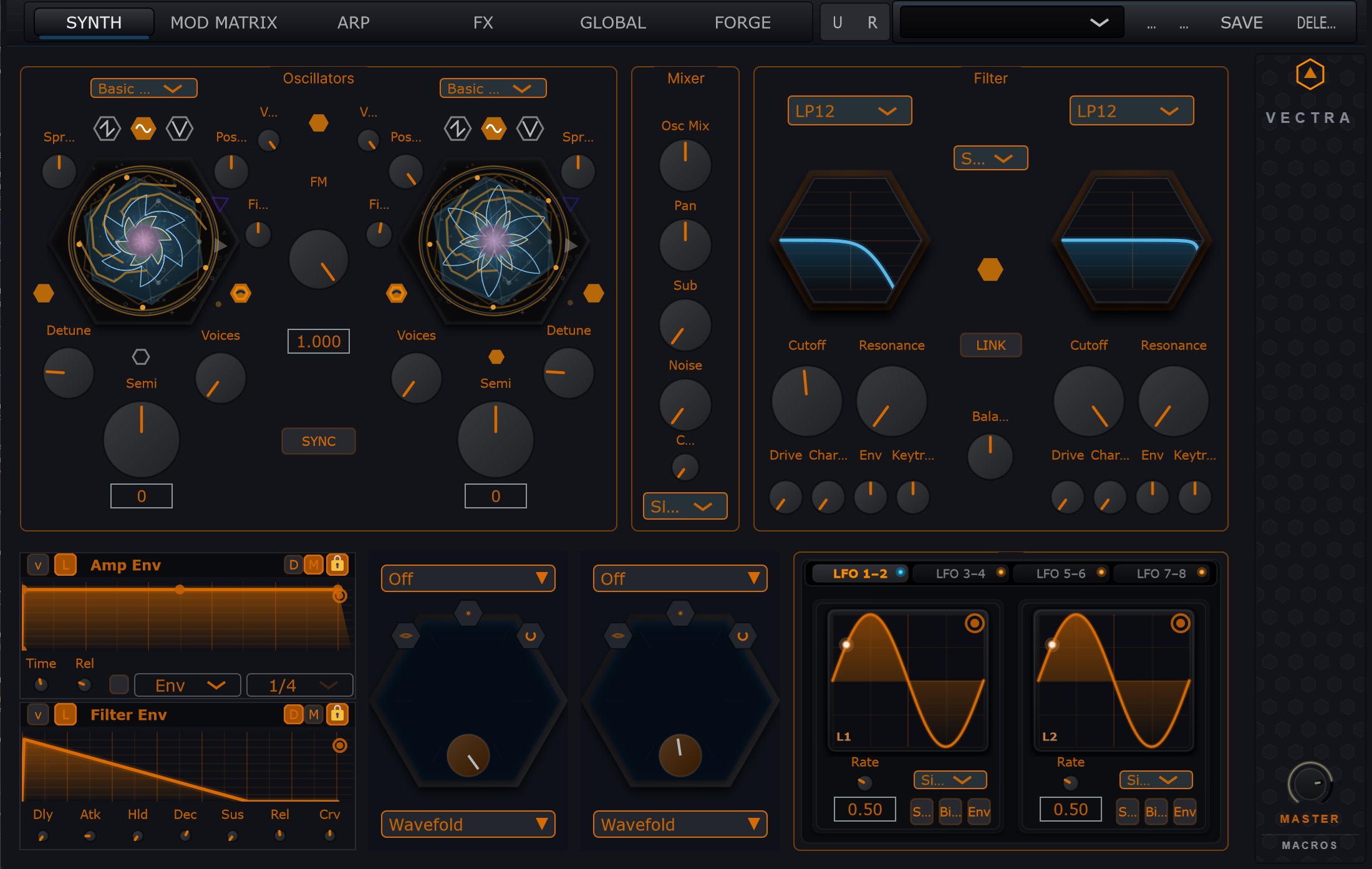
If you’ve been producing for more than five minutes, you know the ritual:
Load an init patch
Turn on unison
Set voices to 7 or 9
Crank the detune knob
Instant Super-Saw. Instant “big”. And for the last decade, that linear, predictable wall of sound has basically been the industry standard.
But if you’ve ever A/B’d that standard VST supersaw against a Virus TI, a JP-8000, or modern flagship synths used in film scoring and psytrance, you’ll have felt it:
The usual unison stack is loud, but it’s flat.
It’s mathematically correct, but psychoacoustically boring.
With the latest VECTRA update, we did not “improve the detune curve” or add a gimmick spread knob.
We ripped out the entire unison subsystem and replaced it with the Titan Unison Architecture – a psychoacoustically-driven engine with 7 distinct modes that treat unison as a texture generator, not a checkbox.
This post is the deep dive: what Titan actually does differently, what’s happening under the hood, and how it changes the way your pads, leads, and basses sit in a mix.
The Problem with “Math-Only” Unison
Classic software unison is usually:
Voices: evenly spaced in pitch (linear cents spread)
Pan: evenly spaced from Left to Right
Gain: every voice at the same level
Phase: either all aligned, or all completely randomized
The result is a “phase wall”:
You get a lot of level, but very little depth.
Everything moves together, so the sound feels more like one big oscillator than a swarm of slightly different instruments.
The center of the stereo image gets clogged, fighting your kick, bass, and snare.
Mathematically, this is fine. Psychoacoustically, it’s underwhelming.
The human ear is not a spectrum analyzer. It responds to:
how energy is distributed in space (pan, width),
how similar or different the spectral content is between voices,
tiny differences in timing and modulation,
and how all of that evolves over time.
Titan’s design starts from those principles. It doesn’t just detune some copies – it shapes pitch, pan, amplitude, phase, and even harmony as a system.
We call that system a Spectral Ecosystem.
The 7 Titan Modes
Each Titan mode is a different “ecosystem” – same oscillator, same note, completely different perception.
1. CLASSIC – The Reference
This is the gold standard of “pure” unison:
Linear pitch spread
Linear stereo spread
Uniform amplitude across voices
Coherent phase (when Phase Rand is low)
Use it for:
tight EDM leads,
hardstyle screeches that need precision,
any situation where you want clarity first and thickness second.
Think of Classic as your control group. When in doubt, start here and A/B everything against it.
2. HYPER – The Swarm
Hyper is where we go full Hypersaw / Virus-inspired density.
Under the hood:
The pitch spread follows an exponential curve:
inner voices cluster around the fundamental,
outer voices are pushed harder than a linear spread.
Stereo is slightly non-linear: edges are widened more than the center.
Amplitude is shaped so that:
the center voices are slightly de-emphasized,
the outer voices get more energy.
The psychoacoustic effect:
The center stays usable – plenty of space for your kick and bass.
The sides explode with movement and richness.
With 7–16 voices, you get that classic “buzzing swarm” that feels alive even before any modulation.
Use Hyper when you want your sound to feel like it’s ripping out of the speakers, but still leave room in the mix for other elements.
3. DIFFUSED – The Cloud
Diffused is the “ambient designer’s” mode.
The idea: instead of a wall, think fog.
The DSP:
Pitch uses a Gaussian-inspired spread:
center is strong, edges taper off smoothly.
Amplitude is shaped with a bell curve:
center voices are louder, outer ones softer.
Pan uses a scrambled mapping:
voices aren’t simply “left to right”; they are decorrelated across the stereo field.
A small, controlled amount of pitch jitter softens the edges.
The result:
The sound feels more like a reverb tail or a smeared choir than a stack of oscillators.
Perfect for:
pads that should float behind the track,
drones,
cinematic swells that need width without harshness.
If Classic is a laser and Hyper is a chainsaw, Diffused is a cloud of mist lit from behind.
4. BINAURAL – Psychoacoustic Width
Binaural is the mode that makes headphones blush.
The structure:
Voices are arranged in strict Left/Right alternation:
Voice 0: L
Voice 1: R
Voice 2: L (a bit closer to center)
Voice 3: R (a bit closer to center)
and so on…
Pitch detune is linked to pan:
what you hear hard left is also slightly differently tuned than what you hear right.
Amplitude is shaped to gently dip the center, to avoid mono clumping.
The psychoacoustics:
On headphones, the sound feels like it’s outside your head.
On speakers, you get a large, stable stereo image that doesn’t collapse when you sum to mono, but still feels dramatically wider than Classic.
Use Binaural when you want:
massive psytrance bass layers,
wide FX swirls,
anything that should feel “3D” without needing external stereo effects.
5. CHAOS – Organic Instability
Modern digital synths are almost too perfect. Chaos mode is the answer.
What it does:
For every note, every time:
pitch deviations are randomized within a controlled range,
pan is randomized,
amplitude is randomized,
phase has extra randomness on top of the global “Phase Rand” control.
The distribution is recalculated per note, so two chords with the same MIDI data won’t sound bit-for-bit identical.
The effect:
At low Chaos, it feels like a more “human” unison.
At high Chaos, you get unstable, broken, glitched behavior:
great for IDM, glitch, experimental psy, and cinematic texture beds.
This is where VECTRA stops sounding like a polite synth and starts sounding like a pile of slightly sick analog modules arguing with each other.
6. SHADOW – The Octave Stack
Shadow mode turns a single oscillator into a vertical spectrum stack.
Instead of just detuning voices around the root, Titan does:
Core pitch stays at the fundamental,
Selected outer voices are fixed at:
−12 semitones (sub octave),
+12 semitones (upper octave),
Remaining voices fill in around the root with tighter fine detune and balanced stereo.
We also shape amplitude:
Root voices are the loudest,
Octave voices are slightly softer to avoid overpowering the fundamental.
What you get:
The weight of a sub oscillator,
The body of the mid,
The brightness of the top octave,
All from one oscillator, in one mode.
Perfect for:
trance supersaws where you need instant depth,
cinematic hits,
one-oscillator patches that feel like a full stack.
7. FIFTH – The Techno Stab Machine
Fifth mode is pure harmonic utility: root + fifth + octave baked into unison.
Voice layout:
Voices cycle through intervals:
0 semitones (root),
+7 semitones (perfect fifth),
+12 semitones (octave),
Spread across stereo with controlled hard panning pairs,
Amplitude shaped so:
root is strongest,
fifth slightly lower,
octave a bit lower again.
Why it matters:
You get instant power chords and “classic stab” voicings without drawing chords in MIDI.
Because it’s generated at the DSP level, the intervals are:
phase-coherent,
punchy,
and tightly glued together in a way three separate oscillators sometimes are not.
Use it for:
dub techno stabs,
rave leads,
any genre that loves root+fifth movement but doesn’t want to micromanage MIDI voicings.
The Drift Factor: From Code to Voltage
Most plugins have some kind of “analog” switch. Often it’s just a slow LFO on pitch.
Titan’s Drift control is different.
Under the hood, Drift:
Applies static, per-voice offsets to pitch when a note is triggered,
Adds small, constrained “slop” on top of the detune layout rather than replacing it,
Is scaled so that:
low Drift = subtle life and width,
high Drift = obvious “vintage” instability.
What that means in practice:
Each unison voice has its own little tuning idiosyncrasy, consistent for that note’s lifetime.
When you play chords or sequences, they don’t sound like perfect clones being transposed – they sound like slightly imperfect oscillators responding in character.
Turn Drift to 0% and Titan behaves like a modern, precise digital synth.
Turn Drift towards 100% and it crosses into “is this hardware?” territory.
Putting It All Together: Titan as a Sound Design Tool
Once you understand that Titan isn’t just “more voices + detune”, you start using it differently:
Shape space before FX.
A Diffused pad through a simple reverb will sound more complex than a Classic pad through three expensive FX chains.Mix inside the unison.
Hyper and Binaural modes effectively pre-mix the stereo field and center energy, so your EQ and sidechain compression have an easier job.Design harmony at the oscillator level.
Shadow and Fifth let you audition harmonic stacks quickly without rewriting MIDI every time.Inject life intentionally.
Chaos and Drift are not random “analog” checkboxes; they are controllable dimensions of movement and instability.
The big picture:
Unison is no longer a “make it louder” button.
It’s now a primary sound design axis in VECTRA.
Practical Starting Points
A few quick recipes to get you going:
Modern EDM Lead:
Mode: Hyper
Voices: 7–9
Detune: 40–60%
Width: 60–80%
Drift: 10–20%
Phase Rand: low (for punch)
Cinematic Pad:
Mode: Diffused
Voices: 9–16
Detune: 30–50%
Width: 100%
Drift: 40–60%
Phase Rand: medium–high
Psytrance Binaural Bass Layer:
Mode: Binaural
Voices: 5–7
Detune: 15–30%
Width: 100%
Drift: 10–30%
Sum to mono and check the “hollow” center – then let your main bass sit there.
One-Oscillator Monster Stack:
Mode: Shadow or Fifth
Voices: 7–9
Detune: 20–40%
Width: 70–100%
Drift: taste
Add a bit of saturation and a gentle high shelf – done.
Conclusion: Beyond the Super-Saw
The Super-Saw era made unison a formula:
More voices + detune = bigger sound.
Titan’s goal in VECTRA was to break that formula wide open and treat unison for what it really is:
a spectral sculpting tool,
a stereo imaging engine,
and in the Shadow/Fifth modes, a harmonic generator.
Classic still gets you the tight, efficient stack you know.
But Hyper, Diffused, Binaural, Chaos, Shadow, and Fifth open new doors:
from swarms and fogs,
to 3D stereo illusions,
to instant chordal weight.
If you’re already deep into synthesis, Titan gives you a more expressive, controllable playground.
If you’re just starting out, it turns a single unison knob into a curated library of usable, mix-ready textures.
VECTRA’s Titan Unison Engine doesn’t just make your sounds bigger.
It makes them richer, more dimensional, and more alive.
Update now, load an init patch, switch through the 7 modes… and actually listen to how the space changes.
Once you’ve felt that, going back to a basic linear supersaw will be very hard.
Author: Samuel Zimmermann (Parandroid)
Tags: #SoundDesign #VST #DSP #Synthesis #VECTRA #MusicProduction #Unison
Join the VECTRA Beta