What “Procedural” Really Means in VECTRA
Explore Infinite Possibilities
Understanding Procedural Wavetable Synthesis in Practice
The term procedural is frequently used in modern audio software, often without a clear technical definition. In the context of VECTRA, however, procedural has a very specific meaning that directly impacts how sounds are created, transformed, and explored.
This article explains what procedural wavetable synthesis means in VECTRA, how it differs from traditional scannable wavetable synthesizers, and why this architectural difference matters for sound designers and producers.
Procedural vs. Static Wavetable Synthesis
Most wavetable synthesizers rely on pre-authored, static wavetable libraries. These tables are created in advance, stored as assets, and scanned during playback. Modulation typically changes the scan position, interpolation, or playback behavior, but the underlying waveform data itself remains fixed.
VECTRA takes a fundamentally different approach.
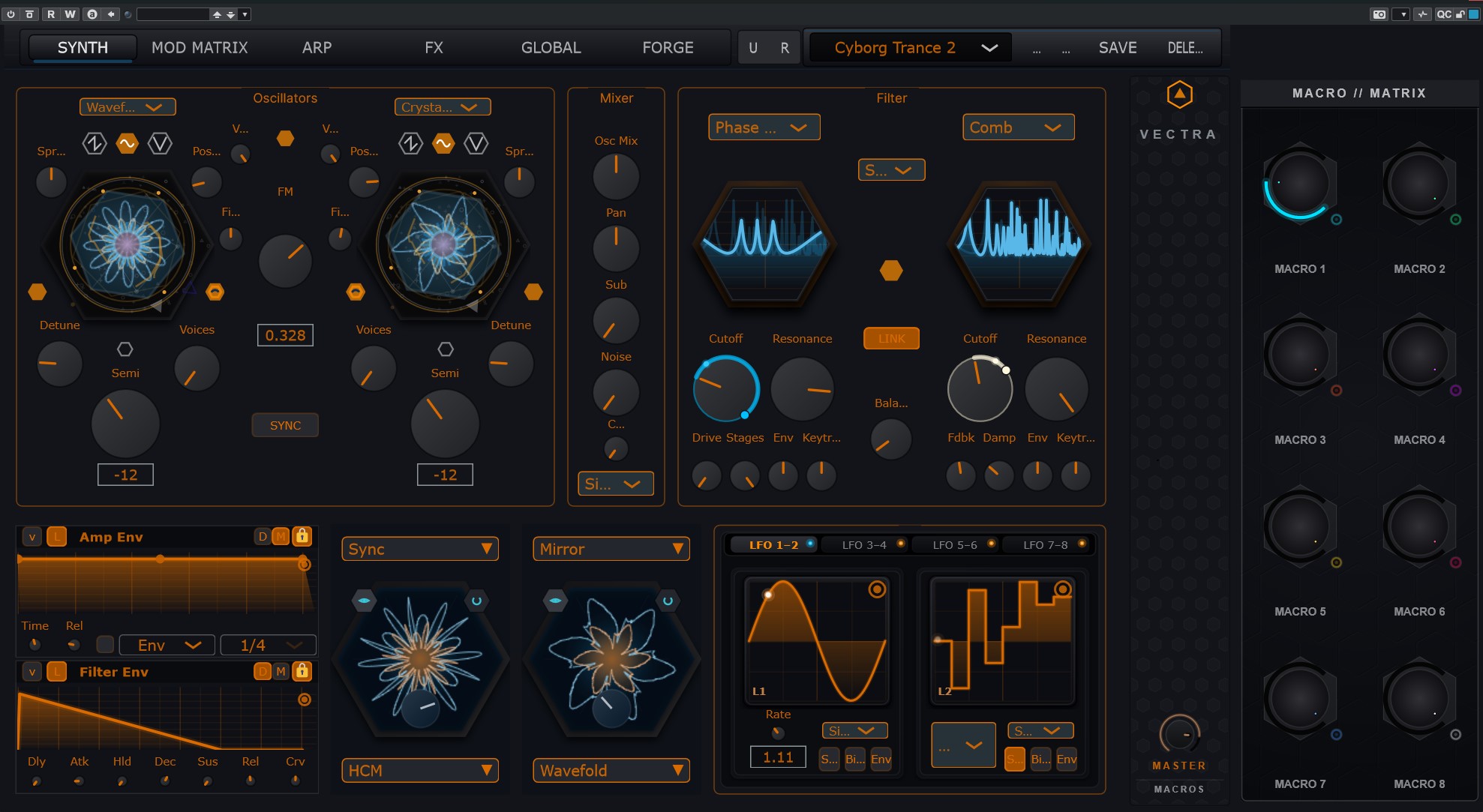
VECTRA does not ship with a library of pre-made wavetables. Instead, all wavetables—including those visible in selection menus—are generated at runtime by the engine based on rules, parameters, and mathematical construction.
In short:
Static wavetable-based synthesis
→ Reads from pre-authored waveform tables
Procedural wavetable synthesis (VECTRA)
→ Generates the wavetable structures on the fly at runtime
This distinction is the core meaning of procedural in the context of VECTRA.
Why Procedural Wavetable Synthesis Matters
Because the wavetable structures themselves are generated rather than loaded, transformation in VECTRA operates on structure, not selection. Instead of browsing or swapping fixed tables, the sound evolves by modifying the underlying model that produced the wavetable in the first place.
This enables a workflow focused on construction, mutation, and exploration, rather than asset management.
VECTRAForge: Core Sound Construction
At the center of the system is VECTRAForge, the core sound-construction layer.
Rather than loading samples or wavetable files, VECTRAForge operates at a spectral / modal level, mathematically constructing:
Harmonic structures
Partial relationships
Resonant behavior
These constructed spectral structures are then packed into usable, scannable wavetable representations that can be explored and transformed within the instrument.
Parameter changes do not select different stored waveforms. They directly affect how the sound is built, allowing deep variation without switching sound sources.
AWC (Advanced Wave Core)
AWC (Advanced Wave Core) operates on the procedurally generated wave and spectral structures produced by VECTRAForge.
Because these structures are not static assets, AWC does not rely on fixed oscillator tables. Instead, it works directly on generated data, enabling transformations that would not be possible in systems based on pre-authored wavetables.
Warp and Mutate: Structural Transformation
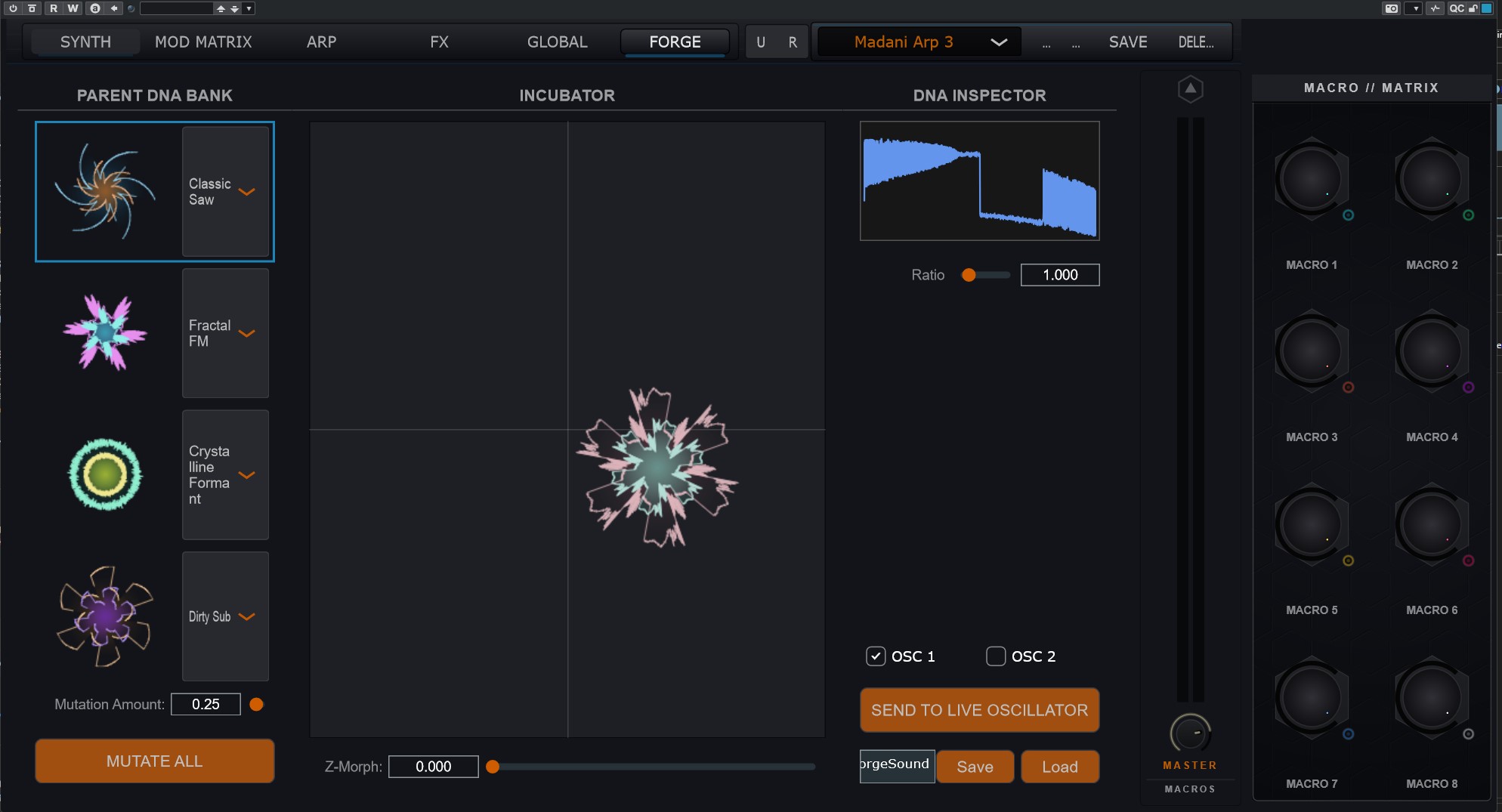
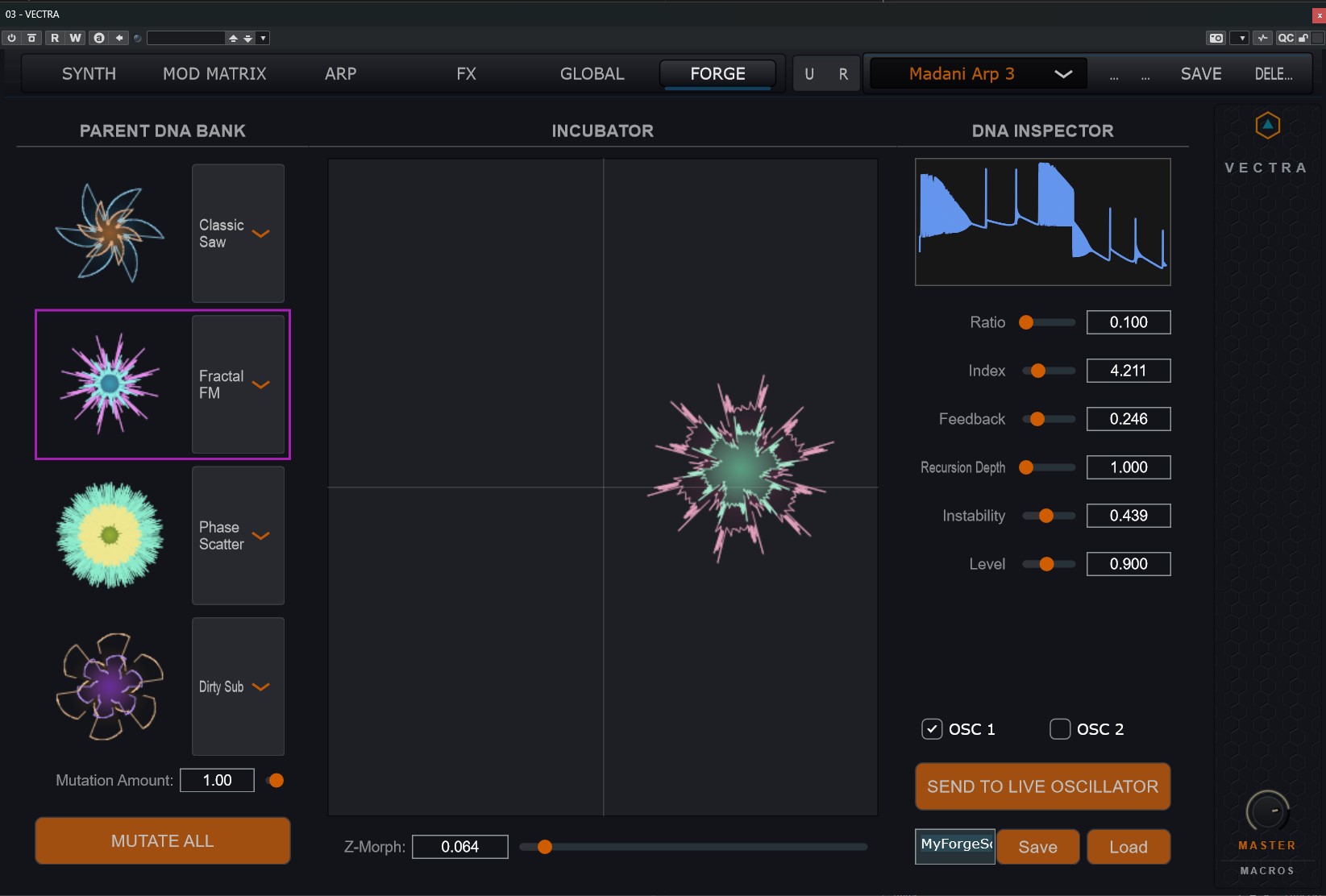
VECTRA’s Warp and Mutate functions operate on the generated wavetable and spectral structures themselves.
Mutate
Available in two modes:Baked
DNAFlux (real time)
Mutation alters the generated structure rather than switching to a different table.
Warp
Transforms the constructed wave / spectral domain directly, enabling continuous structural change.
Both systems are only viable because the source material is procedurally generated and non-static.
What VECTRA Does Not Use
To avoid ambiguity, VECTRA does not rely on:
Pre-installed wavetable libraries
Static oscillator waveform tables
Sample playback as a sound source
All scannable wave content is generated by the engine itself.
Who This Architecture Is For
VECTRA’s procedural wavetable architecture is designed for producers and sound designers who feel constrained by static wavetable libraries and preset-driven workflows.
Instead of selecting from fixed content, VECTRA encourages building, transforming, and evolving sound structures, making it particularly well suited for experimental synthesis, modern electronic music, and deep sound design.
In One Sentence
VECTRA is a procedural wavetable synthesizer in which scannable wave and spectral structures are generated at runtime by the engine, rather than loaded from pre-authored wavetable libraries.
Closing Note
Join the VECTRA Beta