
Genesis - What if your Synth could think?
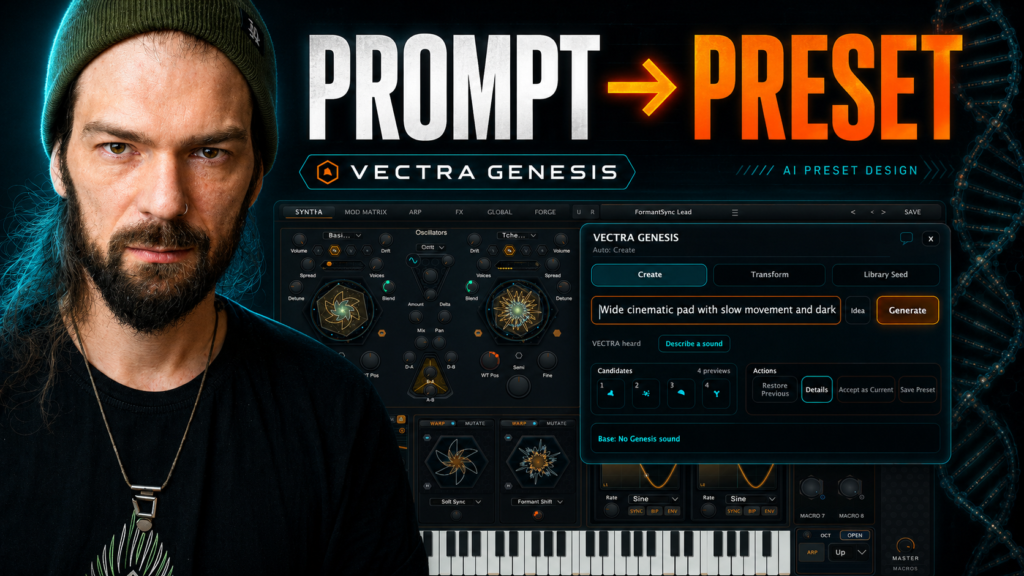
Introducing VECTRA Genesis: From Prompt to Preset
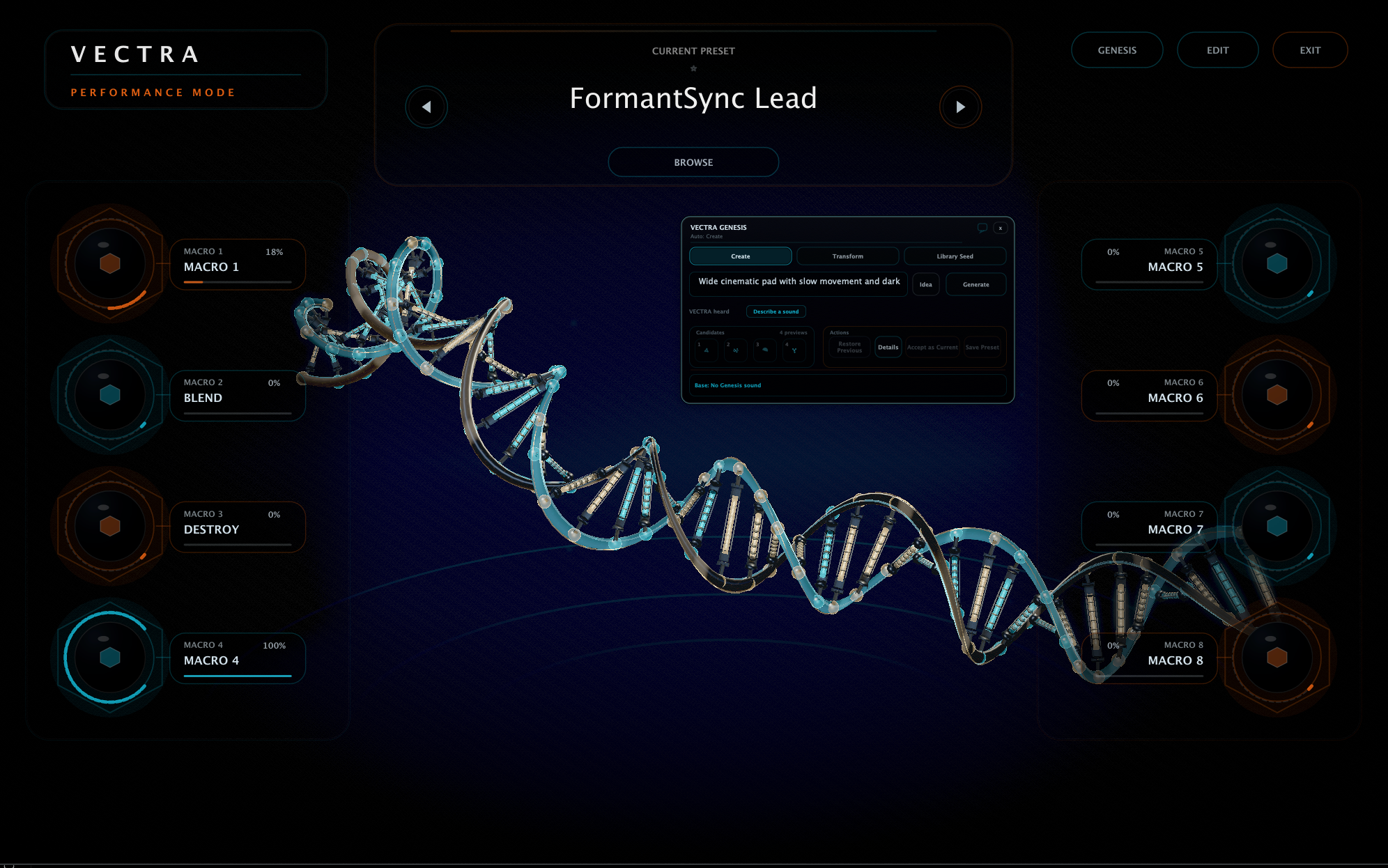
Sound design usually begins in one of two ways: you either start from an initialized patch and build everything manually, or you browse presets until something feels close enough.
Both workflows can work. But they can also slow you down exactly when your musical idea is fresh.
That is why we are introducing VECTRA Genesis.
Genesis is the AI-assisted sound-design layer inside VECTRA. It is built around a simple idea:
Describe the sound. Audition the result. Keep control. Build faster.
Instead of starting every sound from zero, Genesis lets you write a musical direction and generate playable VECTRA preset candidates from that idea.
In other words:
Prompt → Preset
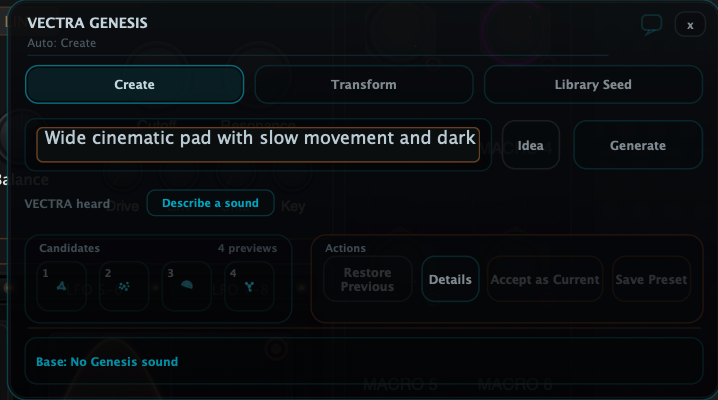
You describe a sound like:
- “A dark rolling psytrance bass with aggressive movement”
- “A glassy futuristic lead for a 150 BPM drop”
- “A metallic FM texture with alien modulation”
- “A soft cinematic pad with slow evolving harmonics”
- “A chaotic hitech FX burst with sharp digital edges”
Genesis then gives you preset candidates that can be auditioned inside VECTRA.
The important part: Genesis does not replace your ears. It gives you starting points, variations, and directions. You still decide what is good.
What is VECTRA Genesis?
VECTRA Genesis is an AI-assisted preset-generation and transformation workflow inside VECTRA.
It helps producers move from musical intent to playable sound faster. You can describe a sound, generate candidates, preview them, accept the result, transform it further, or keep editing manually inside the synth.
Genesis is not a separate chatbot sitting next to the instrument. It is part of the VECTRA sound-design workflow.
That distinction matters.
A generic AI chatbot can talk about sound. Genesis is being designed to create VECTRA-native preset candidates inside the instrument itself.
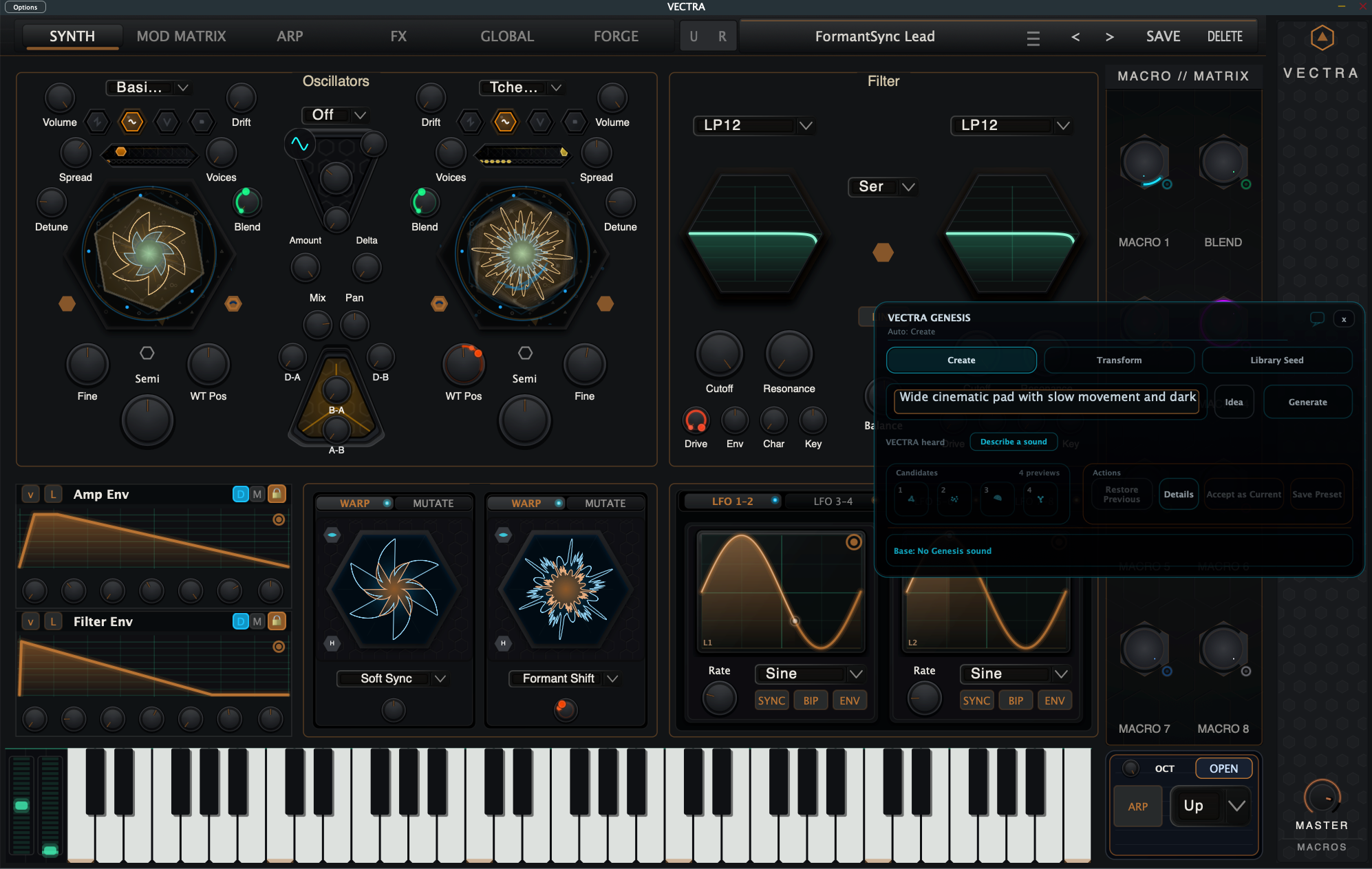
Watch VECTRA Genesis in action
The best way to understand Genesis is to see the Prompt → Preset workflow moving inside the VECTRA environment.
Why “Prompt → Preset” matters
Most producers already know what they want before they touch the synth.
You might hear the idea in your head:
- darker
- wider
- more aggressive
- more psychedelic
- more cinematic
- more metallic
- more evolving
- more stable in the low end
The problem is not imagination. The problem is translation.
How do you turn that idea into oscillator choices, filter behavior, modulation movement, wavetable position, effects, macro behavior, and a playable patch?
Genesis is designed to make that first translation faster.
It does not remove sound design. It accelerates the first stage, where a producer often needs a strong direction before fine-tuning the result.
Create, Transform, and Library Seed
Genesis is built around three practical workflows.
Create
Create starts from a written sound direction. You describe the type of preset you want, and Genesis generates new VECTRA candidates from that prompt.
This is the classic “blank canvas to sound” workflow.
Transform
Transform starts from the sound you already have.
This is useful when a patch is close, but not quite there. You may want it darker, tighter, more aggressive, wider, cleaner, more psychedelic, or more mix-ready.
Instead of throwing the sound away, Genesis can help create related variations.
Library Seed
Library Seed uses existing VECTRA material as a starting point for a new direction.
This connects Genesis to the broader VECTRA preset and performance ecosystem, so the instrument can evolve from its own sound world instead of acting like a disconnected generator.
Candidates, not commandments
One of the most important ideas behind Genesis is the candidate workflow.
Genesis should not be understood as a system that gives one perfect answer.
It gives you options.
You audition them. You compare them. You reject some. You accept one. You tweak it. You save it. You transform it again if the idea wants to go further.
The producer remains the artist.
That is the difference between useful AI assistance and gimmick automation.
How Genesis connects to the VECTRA Genome
VECTRA already has a strong identity around living synthesis, DNA-inspired visual language, macro performance, and evolving sound structures.
Genesis fits naturally into that world.
The Genome is the visual and performance identity of the sound. Genesis is the language-driven creation layer that helps initiate, transform, and steer that sound.
Together, they form a more direct workflow:
- Start with a musical idea.
- Turn it into preset candidates.
- Perform and shape the result inside VECTRA.
- Continue refining the sound by ear.
That is the long-term direction: less menu-diving, more musical steering.
What Genesis is not
Because “AI” is used everywhere now, it is important to be clear.
Genesis is not an automatic song maker.
It is not a replacement for sound design knowledge.
It is not a promise that every prompt produces a perfect result.
It is not a generic text-to-audio sample generator.
It is not a chatbot that writes messages back to you.
Genesis is focused on one thing:
Helping producers create and transform playable VECTRA presets from musical direction.
That is the product promise.
Why producers should care
The point of Genesis is not novelty. The point is workflow.
Genesis is useful when:
- you know the sound you want, but programming it from zero would interrupt the session
- you are stuck browsing presets and want a more targeted starting point
- you like a sound but want several related variations
- you want aggressive, futuristic, psychedelic, cinematic, or experimental directions faster
- you want ideas that are connected to VECTRA’s own sound engine
The real value is creative flow.
You stay close to the music instead of getting trapped in technical setup too early.
Built for electronic sound design
VECTRA Genesis is especially exciting for producers working in genres where sound identity matters:
- psytrance
- hitech
- darkpsy
- forest
- techno
- bass music
- cinematic electronic music
- ambient
- experimental synthesis
These styles often need sounds that are not just “nice presets.” They need movement, aggression, detail, modulation, character, and a sense of personality.
That is where prompt-based preset direction becomes powerful.
Instead of searching endlessly for “something close,” you can begin with the intention of the sound itself.
The future of VECTRA sound design
Genesis is part of a larger direction for VECTRA: making advanced sound design faster, more visual, and more musical without taking control away from the producer.
The goal is not to remove the craft.
The goal is to make the first move easier.
You bring the idea. Genesis gives you candidates. VECTRA gives you the engine to shape them.
That is the beginning of the Prompt → Preset workflow.
Explore VECTRA
VECTRA is available from AudioNerdz:
Use code VECTRA10 for 10% off.
More Genesis demos, screenshots, and sound examples are coming soon.