
VECTRA
Motion-First Flagship Synthesizer
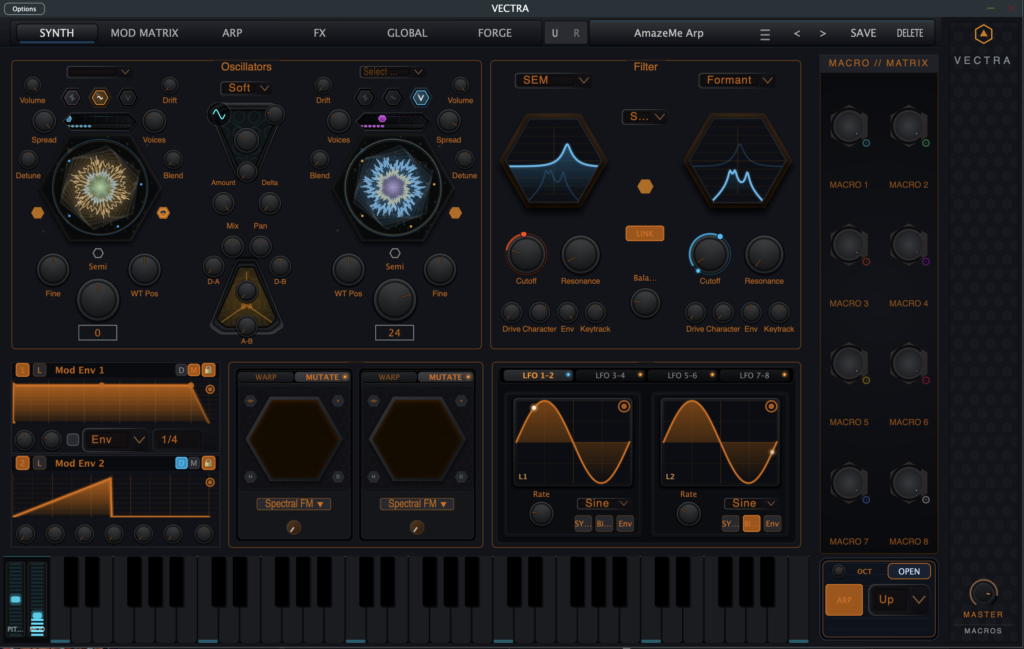
VECTRA is a flagship, multi-layer software instrument built for sound that develops over time. Its identity comes from how voice architecture, authored source material, motion systems, sequencing, filters, and FX interact inside one coherent workflow.
This overview is designed to make the system legible: what each major layer does, how the layers differ, and why they matter in real patch design.
What VECTRA is
VECTRA is not best understood as a single-engine synth with extra features attached. It is a motion-first, multi-layer instrument whose sound comes from interaction: source behavior, authored material, modulation, sequencing, filters, and FX all contributing to how a patch develops over time.
Not a single-lane synth
VECTRA should not be reduced to “just a wavetable synth,” “just a procedural synth,” or “just a preset instrument.” Its character comes from how multiple systems work together.
- Layered voice design instead of flat source stacking
- Motion systems integrated into patch behavior
- Active shaping and finishing inside the same workflow
Built for development over time
The instrument is strongest when sound needs to evolve: basses that keep pressure, leads that stay alive, textures that do not collapse into repetition, and long-form material that continues changing across a phrase or scene.
- Evolving source behavior
- Sequencing and motion inside the patch
- Filters and FX treated as identity, not cleanup
Voice & Source Architecture
At the center of VECTRA is a layered voice design built around Core A, Core B, and Delta Core. This is the structural heart of the instrument. Source behavior then widens through virtual analog and Advanced Wave modes, while authored material from Forge can be reintroduced directly into the live oscillator workflow.
Core A & Core B
Core A and Core B form the main layered source surface. They give VECTRA its ability to combine weight, edge, movement, and hybrid contrast inside the same patch.
- Can carry analog-style body and direct musical weight
- Can move into Advanced Wave playback, scanning, and warp behavior
- Work best as interacting layers, not isolated engine labels
Delta Core
Delta Core is one of the most distinctive parts of the architecture, but it is not simply “oscillator three.” Depending on the patch, it can act as audible source material, internal modulation pressure, or a more reactive excitation layer inside the voice path.
Virtual Analog behavior
VECTRA can move into a more direct, punchy, analog-style role for bass fundamentals, leads, body, and clear musical weight.
Advanced Wave behavior
VECTRA also supports a more fluid digital source identity through wavetable playback, scanning, warp, and transformation-based movement.
Forge Authoring Environment
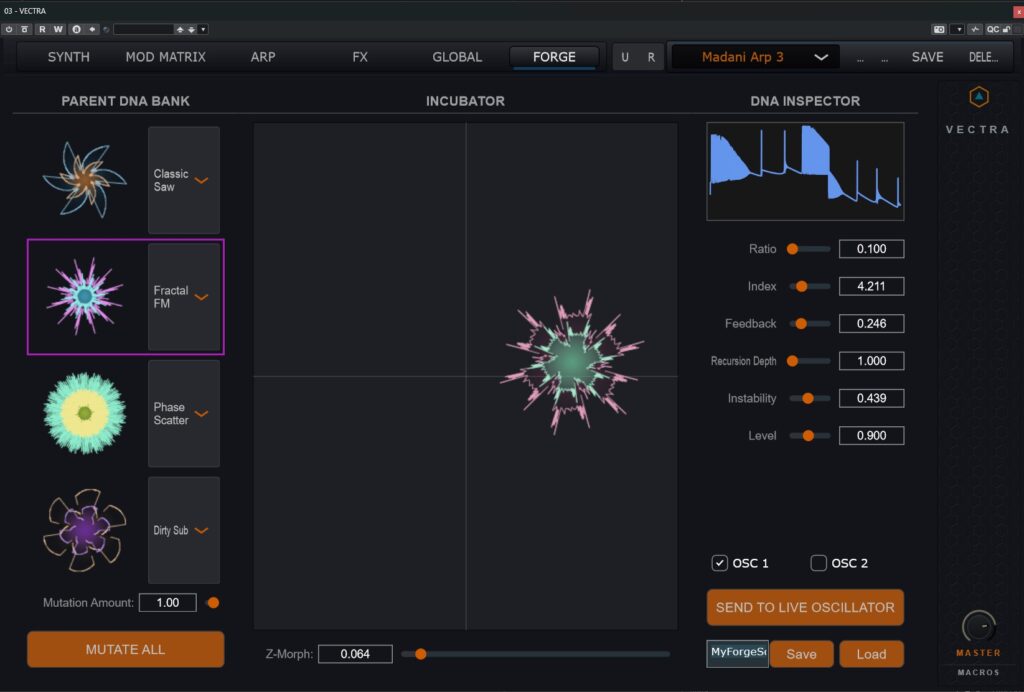
Forge is not a preset browser and not a randomizer with branding. It is VECTRA’s 4-parent wavetable authoring environment: a place to build source material that can be saved, shaped, exported, and fed directly back into the live instrument.
What Forge does
- Selects parent sources as the basis of authored material
- Uses XY blending and incubator logic to combine source identity
- Adds Z-Morph and inspector-style shaping for further control
- Supports save, load, export, and send-to-live-oscillator workflow
Why Forge matters
Forge changes VECTRA from an instrument that only plays source material into one that can also create it. That makes it one of the clearest public expressions of VECTRA’s identity.
- Author new source material instead of relying only on fixed starting points
- Keep authored content inside everyday patch design
- Feed creation and playback into the same workflow loop
Motion Systems
VECTRA is built for sound that keeps developing instead of settling into a fixed loop. Motion is not a final layer added on top. It is built into the way source material is routed, sequenced, and transformed inside the patch.
Living Matrix
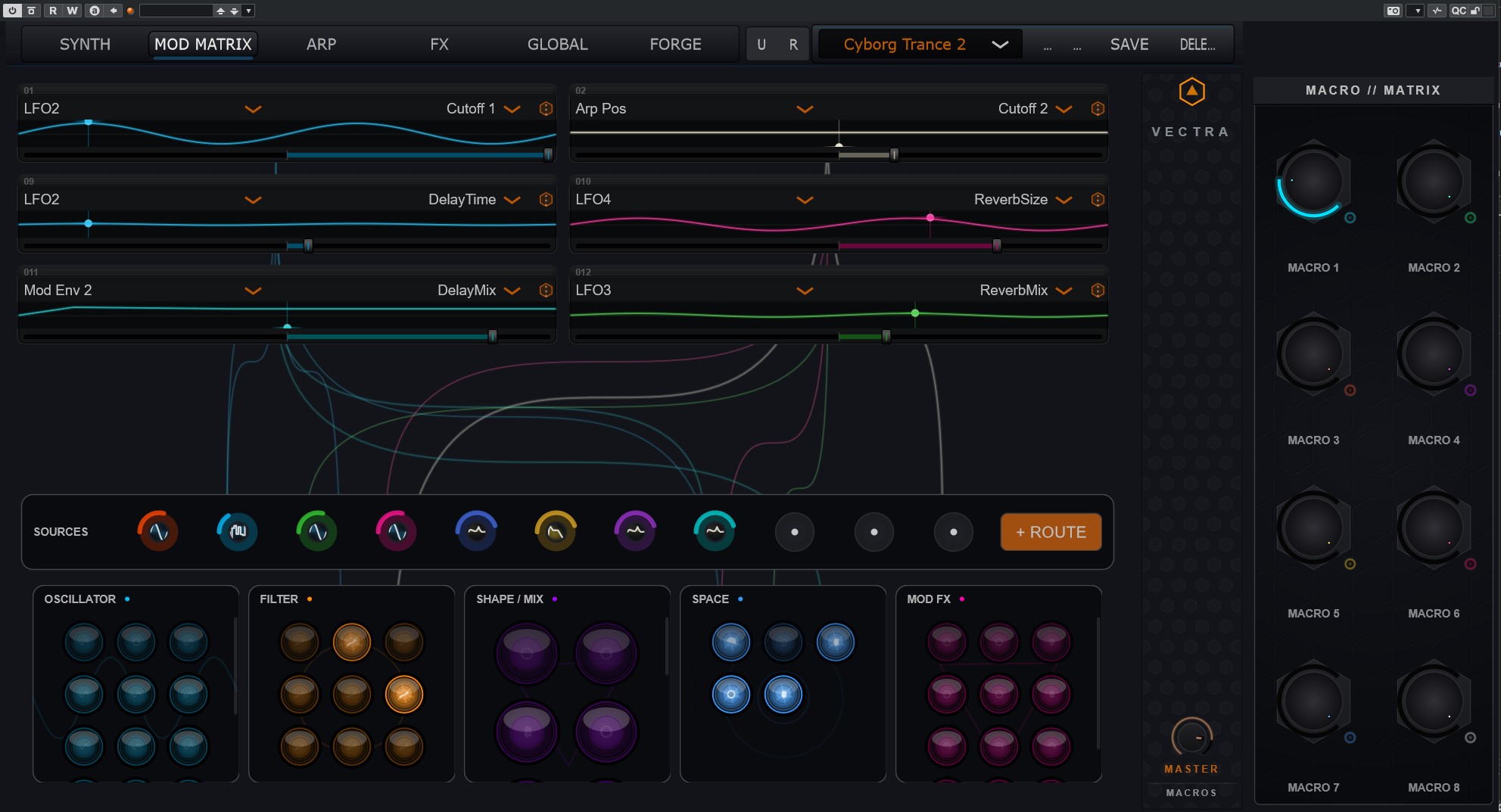
Living Matrix is the routing architecture that keeps modulation central and visually legible. It is designed to let complex movement remain musical and understandable instead of disappearing into menus.
- Up to 32 modulation routes
- Supports fast performance gestures and longer-form movement in the same patch
- Connects source, filter, motion, and FX behavior inside one routing surface
Generators & control sources
VECTRA’s motion architecture becomes most useful when multiple generator types are working together.
- 8 LFOs
- 4 DAHDSR envelopes
- 4 MSEGs
- Macro controls
- Animated routing across the wider architecture
Helios
Helios is not just a basic arp. It is VECTRA’s step-based sequencing and performance layer for rhythmic motion, probability behavior, pitch movement, and evolving pattern variation.
- Step-based movement and variation
- Probability and rhythmic behavior
- Part of the patch architecture, not only note repetition
Musical consequence
These systems are why VECTRA can keep pads unfolding, leads expressive, basses alive, and rhythmic material moving with intent instead of just cycling back to the same state.
Source Transformation
One of the most important distinctions inside VECTRA is that not every kind of movement is doing the same job. Scanning, warp, mutation, DNA Flux, and Forge are related, but they are not interchangeable.
Scanning
Moves through existing wavetable frames. It changes position through already available source material.
Warp
Changes playback behavior in real time. It reshapes the way the source is being played rather than authoring new material offline.
Mutation
Generates new table material. This is not the same as scanning through existing frames or warping playback behavior.
DNA Flux
Introduces live mutated blending during playback. It is a live movement layer, not the same thing as Forge authoring.
Forge
Forge sits apart because it authors the source itself before it returns to the live oscillator workflow. That is why it should not be blurred together with playback scanning, warp behavior, or live mutation.
Dual-Filter Shaping
VECTRA’s filter stage matters because it actively shapes how a patch speaks, not just how it gets darker. The dual-filter architecture is part of the instrument’s identity rather than a simple cleanup stage after source selection.
Architecture
- Dual-filter design
- Serial and parallel routing possibilities
- Balance and link behavior as part of the shaping workflow
- Drive, character, keytracking, and envelope interaction
Musical role
In practice, the filter section can tighten, destabilize, push, or refine the patch depending on the role of the sound. This is why the shaping stage feels like part of the instrument, not just a utility panel.
Maelstrom FX Architecture
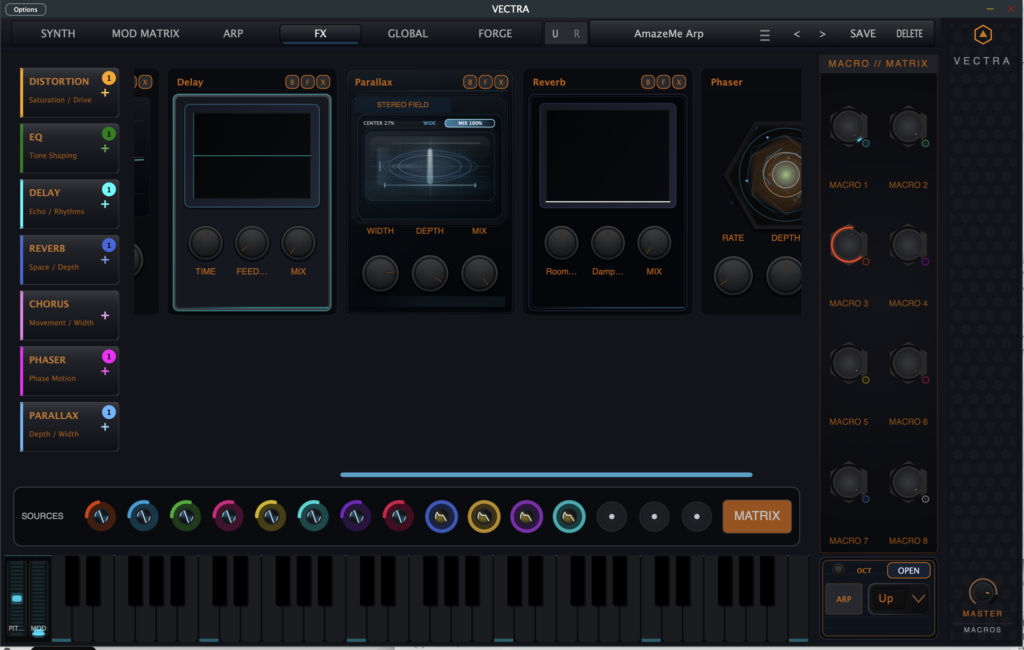
Maelstrom is not an afterthought FX strip. It is a modular FX architecture that extends VECTRA’s sound-design logic into spatial, tonal, and rhythmic processing, allowing the effects stage to participate in the identity of the patch.
Core processors
- Distortion
- EQ
- Delay
- Reverb
- Chorus
- Phaser
Character modules
- Parallax for stereo field and spatial architecture
- Fracture for glitch, slicing, repetition, and pulse manipulation
- Prism for spectral movement and tonal transformation
These modules help define the sound rather than only polishing it after the fact.
Why This Matters Musically
The point of the VECTRA architecture is not complexity for its own sake. The point is to give artists a more flexible, more expressive way to build sounds that keep developing instead of flattening into repetition.
For producers
- Evolving basses with pressure and movement
- Animated leads that stay expressive across a section
- Rhythmic patches with deeper internal motion
For composers
- Long-form tension beds and hybrid textures
- Transformation-driven timbres that can develop over time
- Atmospheric material with internal movement rather than static layering
For sound designers
- Author source material instead of only browsing it
- Build repeatable complexity without losing patch control
- Keep source, motion, shaping, and finishing inside one coherent environment
Core takeaway
VECTRA is best understood as a living sound-design instrument: one where source creation, motion, sequencing, shaping, and FX work together to make sound feel authored from the inside out.
Get Access to VECTRA now