VECTRA
The Living SynthesizerExperience a new level of control in VECTRA ARP CORE
September 2026 Update Notes
VECTRA 2.1.6
ARP CORE
The arpeggiator becomes an instrument.
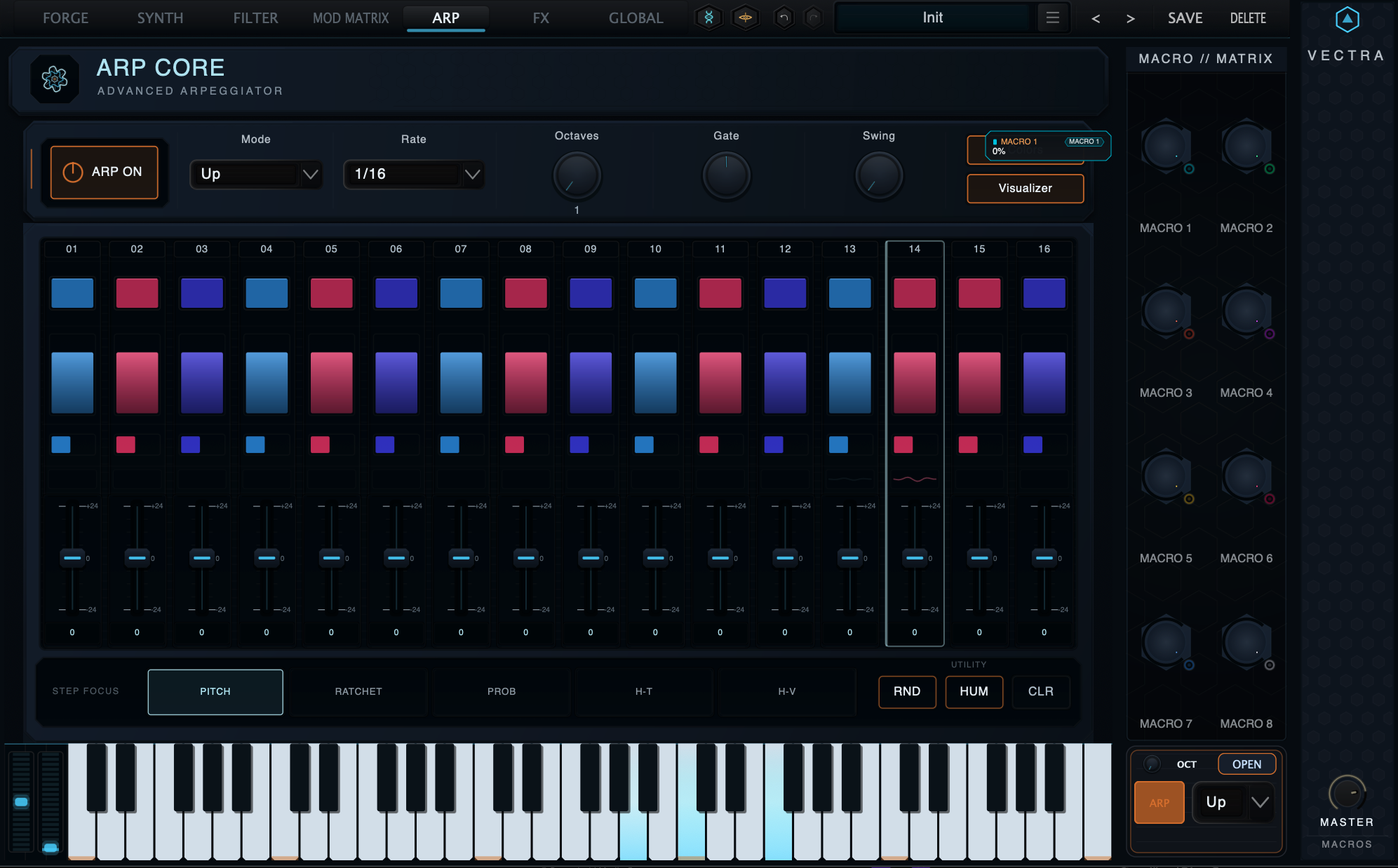
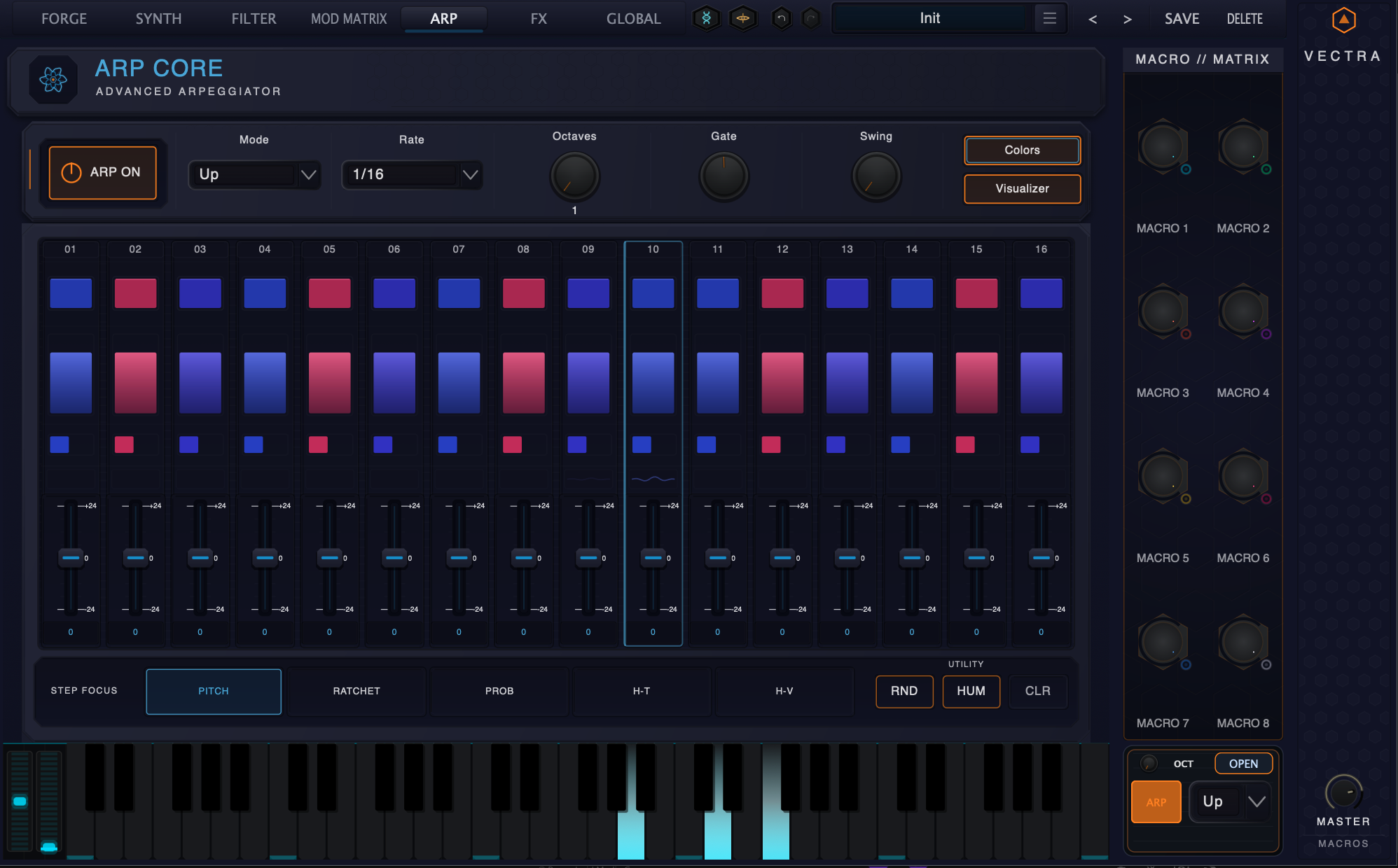
ARP CORE completely reworks how VECTRA’s 16-step arpeggiator is played, edited and understood.
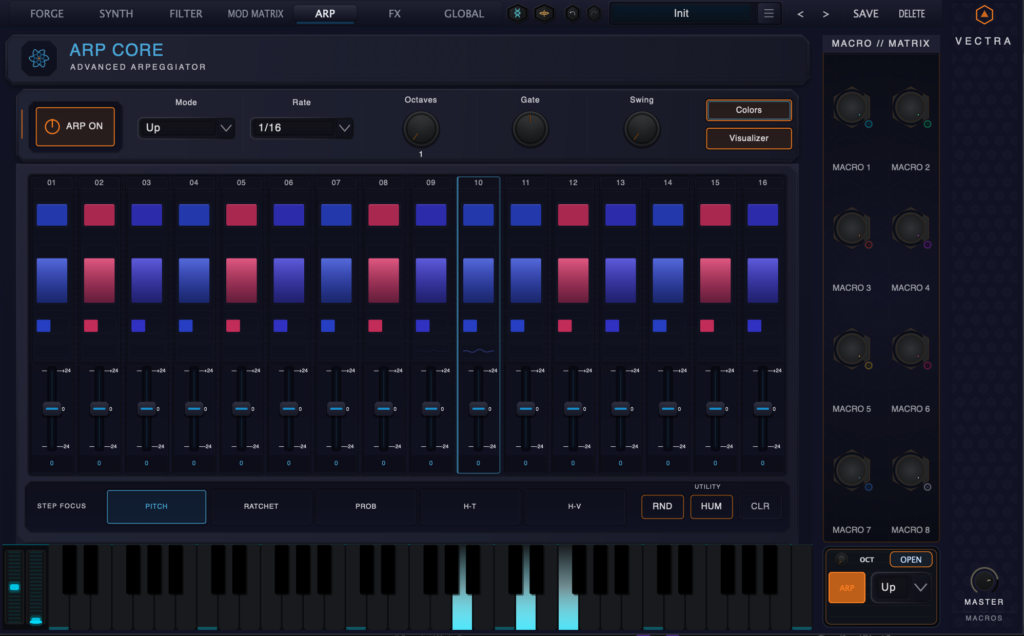
This release takes a system that was already deep and gives it a much more direct interaction model: every step is now a complete sequencing channel, advanced parameters can be shaped across the entire pattern at once, reactive playback is clearer, and the panel itself has been rebuilt around one unified workflow.
16 sequencing channels · Step Focus · Direct editing · Reactive visualizer · Humanize workflow
One panel. One interaction model.
The previous split between simplified and advanced ARP presentation is retired.
VECTRA 2.1.6 now presents ARP CORE as a single unified performance surface.
Instead of moving between different versions of the same sequencer, the full pattern remains visible while deeper controls are brought directly into the 16-step grid.
The result is faster to read, faster to edit and significantly more immediate in use.
Headline Changes
01 // ARP CORE
A completely rebuilt 16-step sequencing surface.
Every step now reads as its own vertical sequencing channel.
At a glance, you can see and manipulate:
- Step enable state
- Velocity
- Gate
- Reactive playback visualization
- Advanced Step Focus value
The pattern is no longer a collection of disconnected editing zones. It behaves like one coherent sequencing instrument.

02 // Step Focus
Advanced editing across the entire pattern.

The biggest workflow change in ARP CORE is Step Focus.
Choose one advanced parameter family and that parameter becomes available across all 16 steps simultaneously.
Available Step Focus modes:
PITCH
Per-step transposition from -24 to +24 semitones.
RATCHET
Per-step repeats from 1 to 8.
PROB
Per-step trigger probability from 0 to 100%.
H-T
Per-step Humanize Timing from -50 ms to +50 ms.
H-V
Per-step Humanize Velocity from -20% to +20%.
The physical control stays in the same place while its scale and meaning change with the selected mode.
That means advanced sequencing no longer requires jumping between separate inspectors or losing sight of the pattern.
03 // Direct Step Editing
Shape the pattern where you see it.
Core sequencing controls remain directly editable inside each step.
Velocity, Gate and Step state can be adjusted in the channel itself, while Step Focus handles deeper sequencing behavior.
The interaction hierarchy is now much clearer:
Pattern structure above.
Advanced intelligence below.
All 16 steps visible at once.
04 // Reactive Step Visualizer
Playback now follows the step that actually fired.
The per-step reactive waveform visualizer remains part of ARP CORE , but its playback tracking has been corrected.
A long-standing indexing issue could cause the visual response to appear one step ahead of the step actually being heard.
VECTRA 2.1.6 now tracks the actually triggered step, keeping the sequencer’s visual feedback aligned with playback.
The existing Visualizer control continues to enable or suppress the reactive layer.
05 // Humanize
HUM now creates real, persistent Humanize state.
The HUM utility now correctly writes Humanize Timing and Humanize Velocity into VECTRA’s actual parameter state.
Previously, the command could appear to do nothing because its generated values were written only into temporary runtime state and were then replaced by the authoritative parameter values.
That path is now corrected.
Press HUM and the generated H-T and H-V variation becomes real sequencer state — visible through Step Focus and retained by the normal VECTRA parameter system.
Utility Controls
RND / HUM / CLR
The main pattern utilities have been condensed into a cleaner command group.
RND — Randomize
Generates a new core pattern variation.
HUM — Humanize
Creates per-step timing and velocity variation.
CLR — Clear
Returns the main step pattern controls to their cleared state.
Shorter labels keep the utility area compact while leaving more space for the sequencing surface itself.
Visual & Interaction Overhaul
Built around the pattern.
ARP CORE also receives a substantial visual rebuild.
The new panel introduces:
- a stronger 16-channel rhythm
- recessed step chambers
- dedicated precision controls for advanced parameters
- clearer selected-step authority
- improved active-state hierarchy
- more disciplined graphite and signal-color treatment
- tighter utility organization
- improved spacing throughout the top control deck
The goal was not simply to make the ARP larger.
It was to make the information hierarchy obvious enough that a deep sequencer can still be operated quickly.
A More Focused ARP CORE
Less interface switching. More pattern awareness.
The previous advanced footer workflow has been absorbed into the main sequencing surface.
Instead of selecting steps and then looking elsewhere for deeper controls, Step Focus keeps the relevant parameter directly under each step.
This makes comparative editing much easier.
Want to build a melodic sequence? Select PITCH and see every offset at once.
Want controlled repetitions? Select RATCHET.
Want to loosen the groove? Move into H-T or H-V.
The entire pattern remains readable throughout.
Refinements & Fixes
VECTRA 2.1.6 also includes several smaller ARP CORE corrections and refinements:
- corrected reactive visualizer step alignment
- corrected persistent Humanize parameter writes
- improved bipolar Pitch control presentation
- refined Octaves value spacing
- improved Step Focus selection and editing behavior
- maintained existing advanced-feature entitlement enforcement
- retained compatibility with the existing ARP parameter architecture
- refined reactive repaint behavior inside the sequencer surface
Licensing & Account Reliability
VECTRA 2.1.6 also includes a substantial reliability pass for account authorization and license management.
- Improved License Center refresh behavior and feedback.
- Improved Sign Out → Sign In recovery when authorization data has become stale.
- Improved persistence and recovery of local device authorization across restarts.
- Fixed cases where fresh paid-license restoration could fail after account or server-state changes.
- Improved synchronization between local authorization state and the Audionerdz licensing service.
- Improved VECTRA / AEGIS same-machine device authorization consistency.
- Added additional safeguards against incomplete local credential updates.
No action is normally required after updating. If you previously experienced a licensing issue, use License Center → Refresh, or Sign Out and Sign In again if necessary.
Why This Release Matters
ARP CORE has always had considerably more depth than a basic up/down arpeggiator.
Probability, ratcheting, per-step pitch, timing variation, velocity variation, gate shaping and reactive sequencing were already part of the system.
The problem was access.
2.1.6 is the release where those capabilities become one coherent instrument.
The underlying depth remains.
The distance between seeing an idea and editing it is much smaller.
VECTRA 2.1.6
ARP CORE
One panel.
Sixteen channels.
Five advanced sequencing dimensions.
A much faster way into the pattern.
Available through the normal VECTRA update and download flow.