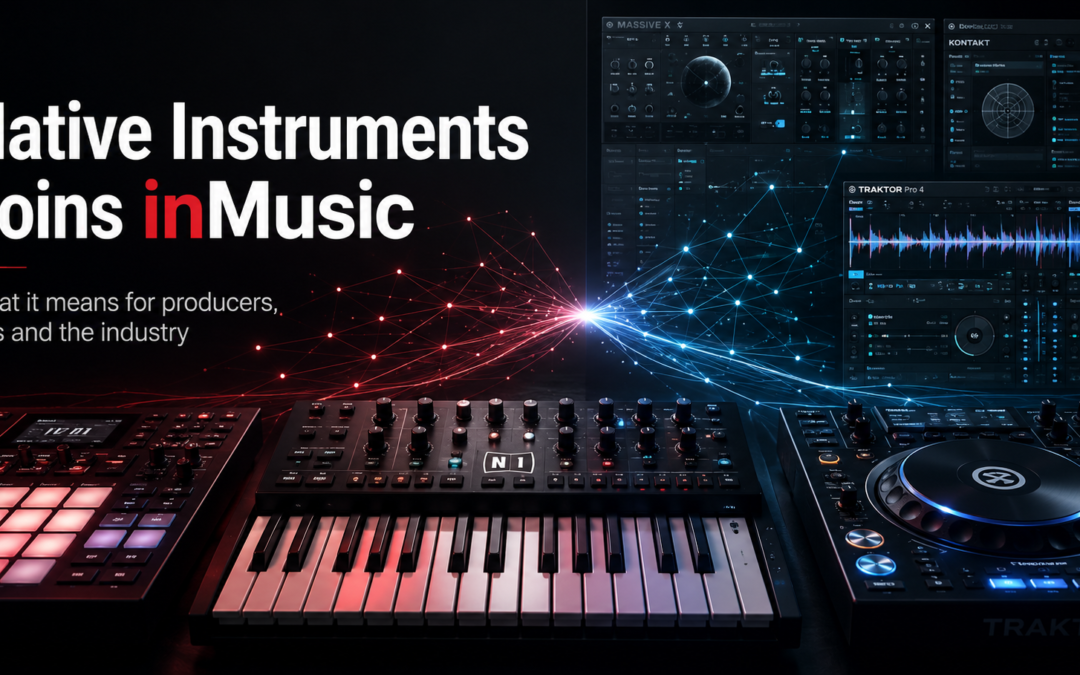
Native Instruments Joins inMusic
NATIVE INSTRUMENTS JOINS INMUSIC: WHAT THIS REALLY MEANS FOR PRODUCERS, DJS AND THE FUTURE OF MUSIC TECH
By Samuel Zimmermann, designer of the VECTRA Synthesizer and founder of Audionerdz.net
There are moments in music technology where a headline looks like business news, but the consequences are deeply personal for the people actually making music.
The news that Native Instruments is being acquired by inMusic is one of those moments.
On paper, this is a corporate acquisition. In reality, it touches almost every corner of modern production: Kontakt libraries, Komplete bundles, Maschine workflows, Traktor DJ setups, Reaktor patches, Massive presets, iZotope mastering chains, Plugin Alliance mixing tools, Brainworx analog modeling, NKS controller integration, and now the massive hardware world of Akai, Moog, Denon DJ, Numark, Rane, M-Audio, Alesis and more.
For producers, DJs, engineers and sound designers, the question is not just “who owns Native Instruments now?”
The real question is: what happens to the tools we depend on?
The Deal: What We Know So Far
On May 8, 2026, inMusic and Native Instruments announced that inMusic has signed a definitive agreement to acquire Native Instruments.
That wording matters. This is not just a rumor. It is a signed agreement. But it is also not the same as saying that every part of the acquisition and integration is already complete. Native Instruments CEO Nick Williams wrote that the companies are working toward completing the transaction in the coming weeks, and that business continues to operate normally in the meantime.
Native Instruments also published an FAQ for users. The short version is: Native Instruments continues as a brand under new ownership. Native Instruments, iZotope, Plugin Alliance and Brainworx continue. Products, licenses, downloads, subscriptions and support remain active. Users do not need to do anything today.
That is the short-term answer.
The long-term answer is much more interesting.
Why This Acquisition Makes Strategic Sense
For years, Native Instruments was one of the companies that defined music production inside the computer. Kontakt became the standard platform for deep sampled instruments. Reaktor gave experimental sound designers a modular software laboratory. Massive shaped entire eras of electronic bass music. Komplete became a studio vocabulary. Maschine tried to fuse beatmaking hardware with software. Traktor became a serious platform for digital DJs.
inMusic, by contrast, has built one of the biggest hardware ecosystems in music technology. Its portfolio includes Akai Professional, Moog Music, Denon DJ, Numark, Rane, M-Audio, Alesis, AIR, BFD, Engine DJ, SoundSwitch and other brands.
That is the central logic of the deal: Native Instruments brings software, sounds, DSP brands, creative IP and a huge user base. inMusic brings hardware, manufacturing knowledge, distribution and ecosystem scale.
This did not come from nowhere. In 2025, NI and inMusic already announced a collaboration that brought NKS integration to Akai and M-Audio controllers, and brought Native Instruments sounds and MPC Editions to the Akai MPC standalone platform. In other words, the bridge had already been built. The acquisition now brings both sides of that bridge under one roof.
What This Means For Producers
For producers, the most immediate takeaway is simple: do not panic.
Your Kontakt libraries do not suddenly disappear. Your Komplete account does not suddenly become useless. Your iZotope plugins do not suddenly stop authorizing. Native Instruments’ own FAQ says existing products, licenses, downloads, subscriptions and support continue.
But medium term, several things become very important.
First, expect deeper integration between Native Instruments software and inMusic hardware. Akai MPC already received NI content through MPC Editions. It would be completely logical to see more Kontakt-derived instruments, NI sound packs, effects, expansions, or simplified performance versions optimized for MPC and other inMusic platforms.
That could be a big win for producers who want less laptop dependency but still want polished software instruments and professional sound libraries.
Second, NKS may become a much more important standard. NKS used to be strongly associated with Komplete Kontrol keyboards. Since 2025, it has expanded toward third-party hardware partners. Under inMusic, NKS could become less of a “Native keyboard” feature and more of a broader hardware/software connection layer across controllers, standalone workstations and plugin ecosystems.
Third, and this is the big one: Maschine now sits under the same ownership as Akai MPC.
Officially, Maschine continues. That is the current message. But strategically, inMusic will eventually need to decide what Maschine is in a company that also owns MPC. These products are not identical, but they overlap in the mind of many beatmakers and electronic producers.
Does Maschine remain a distinct ecosystem? Does it become more integrated with MPC thinking? Does it move toward a controller/software role while MPC owns standalone? Or does inMusic find a way to let both serve different creative cultures?
Nobody outside the company can answer that today.
So if you are a Maschine user, I would not panic. But I would pay very close attention to the roadmap.
What This Means For Djs
For DJs, the headline is Traktor.
Traktor has a legendary name. It also has a complicated recent history. Many DJs love it, but many also feel the platform lost momentum over the years while other ecosystems pushed harder into standalone, club hardware and integrated performance workflows.
Now Traktor joins a company that already owns Denon DJ, Numark, Rane and Engine DJ.
That could be very positive. inMusic already has serious DJ hardware across beginner, mobile, scratch, performance and standalone categories. If Traktor receives real investment and proper hardware alignment, it could become a stronger alternative in a market long dominated by Pioneer DJ / AlphaTheta.
But there is a strategic tension here too. inMusic already has Engine DJ. Traktor is software with a different legacy, user base and workflow. The question is whether inMusic treats Traktor as a premium DJ software platform, integrates its technology into existing hardware ecosystems, or lets the two worlds coexist.
The opportunity is huge. The risk is confusion.
What This Means For Mixing And Mastering Engineers
The acquisition also includes iZotope, Plugin Alliance and Brainworx. That matters because these are not decorative bundle fillers. They are part of real professional workflows.
iZotope RX, Ozone, Neutron and Nectar are used by producers, mastering engineers, post-production people and content creators. Plugin Alliance and Brainworx have a deep catalog of analog-modeled EQs, compressors, console emulations, guitar tools, mastering processors and utility plugins.
The optimistic version is that inMusic gives these brands more stability and a wider path into integrated workflows. Imagine smarter mastering chains, restoration tools, metering, performance effects or mixing tools connected more tightly to controllers and standalone systems.
The cautious version is that the industry keeps moving toward bigger bundles, more subscriptions and more account ecosystems. That does not automatically make the tools worse, but it changes the relationship between users and the software they rely on.
For audio professionals, the question is not whether the plugins work today. They do. The question is whether future licensing, upgrade plans, authorization systems, bundle strategy and platform support remain producer-friendly.
What This Means For The Industry
Zoom out and the bigger picture becomes clear: music technology is consolidating.
The independent era of small, iconic music tech companies is increasingly becoming an ecosystem era. Companies are no longer competing only through one synth, one controller, one plugin or one sampler. They are competing through full pipelines: hardware, software, sounds, accounts, licensing, content platforms, education, marketplaces and creator communities.
inMusic now has an unusually broad map: beatmaking with Akai, synthesis heritage with Moog, DJ hardware with Denon DJ, Numark and Rane, production controllers with M-Audio and Alesis, software through AIR and BFD, lighting through SoundSwitch, and now Native Instruments, iZotope, Plugin Alliance and Brainworx.
That is powerful.
It is also something the industry should watch carefully.
Consolidation can create better integration. It can also reduce competition. It can fund long-term product development. It can also lead to rationalization, layoffs, discontinued products and more closed ecosystems.
For producers, the dream is obvious: one connected world where your controller, sampler, plugin library, synth sounds, DJ software and mastering chain all speak to each other.
The nightmare is equally obvious: fewer independent choices, more subscriptions, forced accounts, discontinued favorites and innovation replaced by bundle strategy.
The truth will depend on execution.
The Berlin Question
As a German producer and instrument designer, this one hits differently.
Native Instruments is not just another software company. It is part of Berlin’s music technology identity. It came from a culture where sound design, club music, experimental DSP and practical production tools met in a very specific way.
That matters because Native Instruments’ value is not only its product names. It is also the people, the design culture, the developer knowledge, the artists, the third-party Kontakt ecosystem, and the trust built over decades.
The smartest thing inMusic can do is not just buy Native Instruments’ catalog. It is to preserve the creative intelligence that made these tools matter in the first place.
My Take As A Synth Designer
As someone who designs instruments, I see both sides.
I understand why users are nervous. We have all seen beloved tools get absorbed, neglected, rebranded, subscription-locked or quietly left behind. In music production, tools become part of muscle memory. A sampler is not just a sampler. A synth is not just a synth. A controller is not just a controller. These things become part of how we think.
But I also think Native Instruments needed a stable next chapter. Insolvency is not an abstract business term when your projects rely on Kontakt, Reaktor, Maschine, Traktor, RX or Plugin Alliance tools. Stability matters.
inMusic has the resources, manufacturing knowledge and hardware ecosystem to do something genuinely interesting with NI. The MPC and NKS connection alone could become a major bridge between computer-based production and standalone workflows. Traktor under the same roof as Denon DJ and Rane could become a serious strategic weapon. Kontakt and iZotope could benefit from investment if inMusic understands that the real asset is trust.
So my position is cautiously optimistic, but not blindly optimistic.
The acquisition is good news if it means continuity, investment and better integration.
It becomes bad news if product overlap is solved by killing tools instead of developing them.
What Producers Should Do Now
Do not panic-sell your Maschine. Do not abandon Kontakt. Do not assume your licenses are unsafe. The official messaging is clear that products and support continue today.
But be practical.
Keep your installers organized where possible. Back up projects. Save stems for important work. Document plugin versions in client sessions. Avoid building mission-critical live shows around assumptions about future roadmap promises that have not yet been announced.
And most importantly: watch the next 12 to 24 months.
Not the announcement. Not the press release. The products.
Will Maschine get meaningful updates?
Will Traktor become more competitive?
Will Reaktor be revived or quietly ignored?
Will Kontakt become stronger for third-party developers?
Will NKS remain open enough to benefit the whole industry?
Will iZotope and Plugin Alliance keep serving professionals instead of just filling bundles?
Will inMusic preserve NI’s Berlin DNA?
That is where the truth will show up.
For now, Native Instruments has survived a dangerous moment and found a powerful new owner. For musicians, that is better than collapse. But the next chapter has to be earned.
The tools still work.
Now we need to see what they build.