
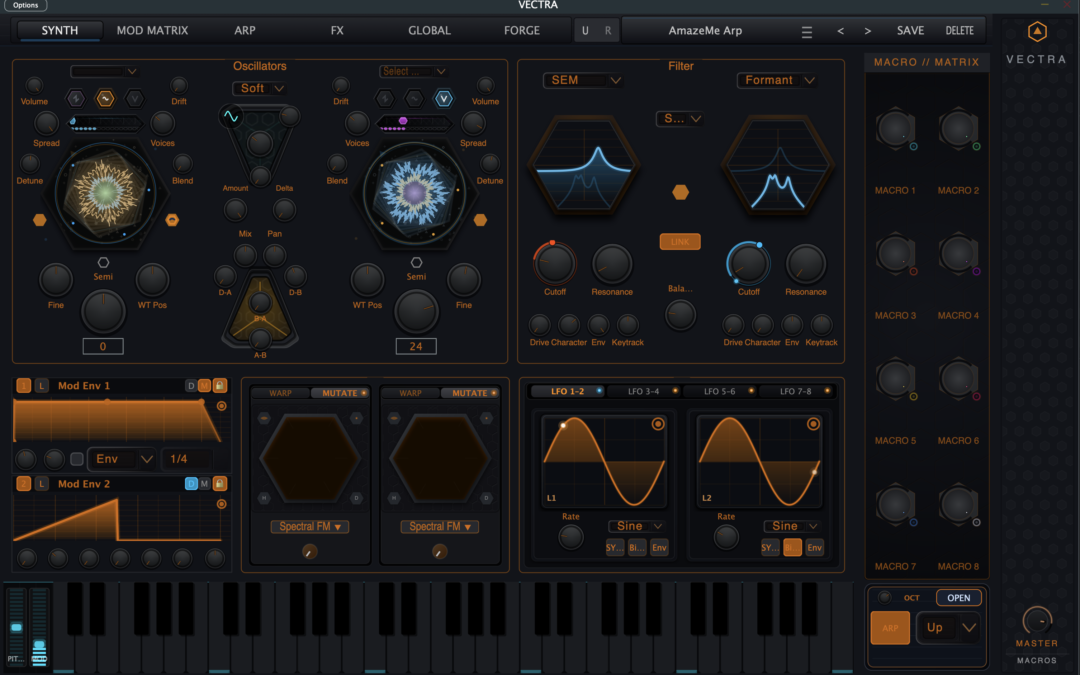
VECTRA Is Leaving Early Access
VECTRA is entering a new phase.
After Early Access, the instrument is moving to a Freemium model. That change matters, but not because of pricing language. It matters because VECTRA is a flagship synth built around interaction between systems, and that kind of instrument is understood best from the inside.
VECTRA was never intended to be reduced to a screenshot, a preset pack, or a single headline feature. Its identity comes from the way its synthesis layers, motion systems, sequencing, filters, and effects work together while you build a patch. Freemium gives more producers, composers, and sound designers a proper way into that experience.
What kind of instrument VECTRA actually is
At its core, VECTRA is a multi-layer synthesis instrument built for movement.
Its voice is not a simple oscillator-filter-effects chain. Each patch is built around two primary cores, Core A and Core B, plus Delta Core, which can act as an audible layer, an operator, or an internal modulation source. That matters in practice because the sound can be built as a stable foundation on one side and a more animated or complex layer on the other, with Delta adding pressure, edge, or internal motion between them.
Each main core can run as Virtual Analog or on the Advanced Wave Core side of the instrument. In other words, VECTRA is not forcing every patch into one synthesis identity. A sound can begin as a direct, solid analog-style voice, as a wavetable-driven voice, or as a hybrid between the two.
That flexibility is one of the reasons VECTRA feels different in use. It is not only about selecting a tone. It is about deciding how the tone should behave.
Why VECTRA sounds alive
On the wavetable side, VECTRA separates several processes that are often blurred together in other instruments.
There is the table itself and the position you scan through. There are real-time warp processes that reshape playback while you perform. There are offline mutation processes that derive new tables from existing material. And there is DNA Flux, which adds its own live mutation layer on top of playback.
Those distinctions are important because they create different kinds of movement.
Warp is immediate and performative. Mutation changes the material itself. DNA Flux introduces another level of evolving behaviour. Used well, that means you are not relying on one trick repeated across the whole synth. You are choosing how deep the transformation should go, and at which layer it should happen.
For producers, that translates into patches that can stay harmonically useful while still developing over time. For composers, it means motion can be built into the timbre instead of added afterwards. For sound designers, it means a patch can be pushed into more extreme territory without immediately losing its internal logic.
Why Forge matters
Forge is one of the systems that defines VECTRA, but it only makes sense when described accurately.
Forge is not a preset browser and it is not a random button dressed up with branding. It is a four-parent wavetable authoring environment. You choose four source recipes, assign them to the corners, blend them in the XY field, shape them further through inspector controls, and use Z-Morph as an additional axis of development. From there, the result can be saved, exported, added to the user library, or sent directly into the live oscillator path.
In use, this gives VECTRA a very different relationship to source material. You are not limited to selecting from a table list and then processing the result. You can build the source itself, move it toward a specific musical role, and then continue shaping it inside the instrument.
That is a major reason VECTRA does not feel like a conventional wavetable synth. The sound source is part of the creative process, not just the starting inventory.
Where movement is really designed
VECTRA’s modulation architecture is central to the instrument, not an accessory page.
The Living Matrix is a 32-slot routing system that connects LFOs, envelopes, macros, note information, and step data to the parts of the synth that matter most: oscillator behaviour, wavetable position, warp amount, DNA Flux depth, filter response, envelope timing, and Maelstrom targets. This is the layer that determines whether a patch simply makes a tone or actually behaves over time.
Helios extends that idea into performance. It is not just an arpeggiator on/off switch. It is a step-performance layer with probability, ratchets, gate variation, pitch offsets, and timing behaviour that can change how a line feels before it ever hits the rest of the arrangement.
Together, the Living Matrix and Helios make VECTRA especially strong for work that depends on controlled motion: psytrance, darker electronic forms, cinematic design, hybrid scoring, and any production style where the patch itself needs to contribute energy, tension, and development.
Why the filter and effects stage matters so much
VECTRA’s sound is not finished at the oscillator stage.
The instrument uses a dual-filter architecture that can run in serial or parallel, with routing, balance, drive, keytracking, and multiple filter models shaping how the patch sits and moves. That section is not there just to shave off highs or add resonance. It is one of the places where a VECTRA patch gains focus, aggression, weight, or contour.
After that comes Maelstrom, the modular effects system. Instead of a fixed strip, Maelstrom is built as a rack where modules can be inserted, ordered, bypassed, and modulated as part of the patch design itself. Delay, reverb, distortion, phasing, spatial widening, fracture-style processing, and spectral colour can all participate in the patch architecture rather than being treated as an afterthought.
That design philosophy is important. In VECTRA, effects are not only polish. They are part of composition, motion, and identity.
Why Freemium is the right move
Freemium makes sense for VECTRA because this is an instrument that reveals itself through use.
With a more conventional synth, a user can often infer the experience from the layout alone. With VECTRA, the real understanding comes when you hear how Core A and Core B interact, when Delta starts influencing the voice, when warp and mutation are used for different purposes, when the Matrix turns static tone into movement, and when Helios and Maelstrom begin shaping behaviour rather than just sound.
That is why VECTRA Free is being introduced as a genuine entry point into the instrument, not as a throwaway trial. It is there so users can work with the core architecture, hear the character of the system, and decide from experience whether they want the wider authoring surface and deeper flagship capabilities of the paid tiers.
What VECTRA Free is for
VECTRA Free is designed to let new users learn the instrument properly and make meaningful work with it.
It opens the door to the core synthesis environment, the main motion-first workflow, baseline Advanced Wave Core functionality, core modulation, core sequencing behaviour, essential filters and effects, and a curated starter surface that reflects the identity of the instrument.
The paid tiers then expand that foundation. Standard opens more of the authoring and sound-design range. Deluxe opens the full flagship surface, including the deepest Forge access, the most advanced motion systems, premium processing, and the broadest version of VECTRA’s architecture.
That is the right upgrade logic for this synth. The paid versions do not replace the instrument. They widen it.
Who VECTRA is built for
VECTRA is built for producers, composers, and sound designers who need sound to develop, not just repeat.
It suits artists working in psytrance, dark electronica, hybrid bass music, cinematic scoring, game audio, and other motion-driven forms because it can move from stable harmonic material into authored complexity without collapsing into randomness. It also suits sound designers who want a synth that can be exploratory while still staying structurally controllable.
If your work depends on evolving timbre, deeper modulation, performance-aware sequencing, and effects that participate in the patch instead of sitting on top of it, VECTRA was built for that kind of practice.
A new entry point for a flagship instrument
Early Access was about building VECTRA into the instrument it needed to become.
Freemium is about opening that instrument properly.
Now there is a clearer way in: start with the core architecture, work inside the real system, and decide from there how far into the wider VECTRA surface you want to go.
Get VECTRA Free.